
How to make online store orders flow into your books and stock counts
By Joseph Gomez Salazar · Paper StPublished Drafted with AI from the public sources listed below. Published by Joseph Gomez Salazar. How we make these guides
Record each payout as full sales, with fees and refunds on their own lines, never as one deposit. Let one system own your stock count. Fees come out before the money reaches your bank (Square's fee help). Refunds come out too. So the deposit is smaller than your sales.
You'll be able to follow one order through 5 stops, pick how to connect, and tie a payout to the bank.
- You'll get
- the order flow, a choice table, and a payout tie-out sheet.
- Expect
- about 5 minutes to read and 15 minutes a week.
- For
- owners of an online store whose books do not match the bank. Not for: stores that build items from parts.
- Do your books show sales equal to your bank deposits?
- Do 2 places change your stock count?
- Is sales tax in your sales total?
All no? Skip to "Use it: 3 steps". Any yes? Start with the 5 stops.
The 5 stops of one order
Every online order stops in 5 places. Each stop changes a different number. In our view, most mismatches come from mixing up 2 stops.
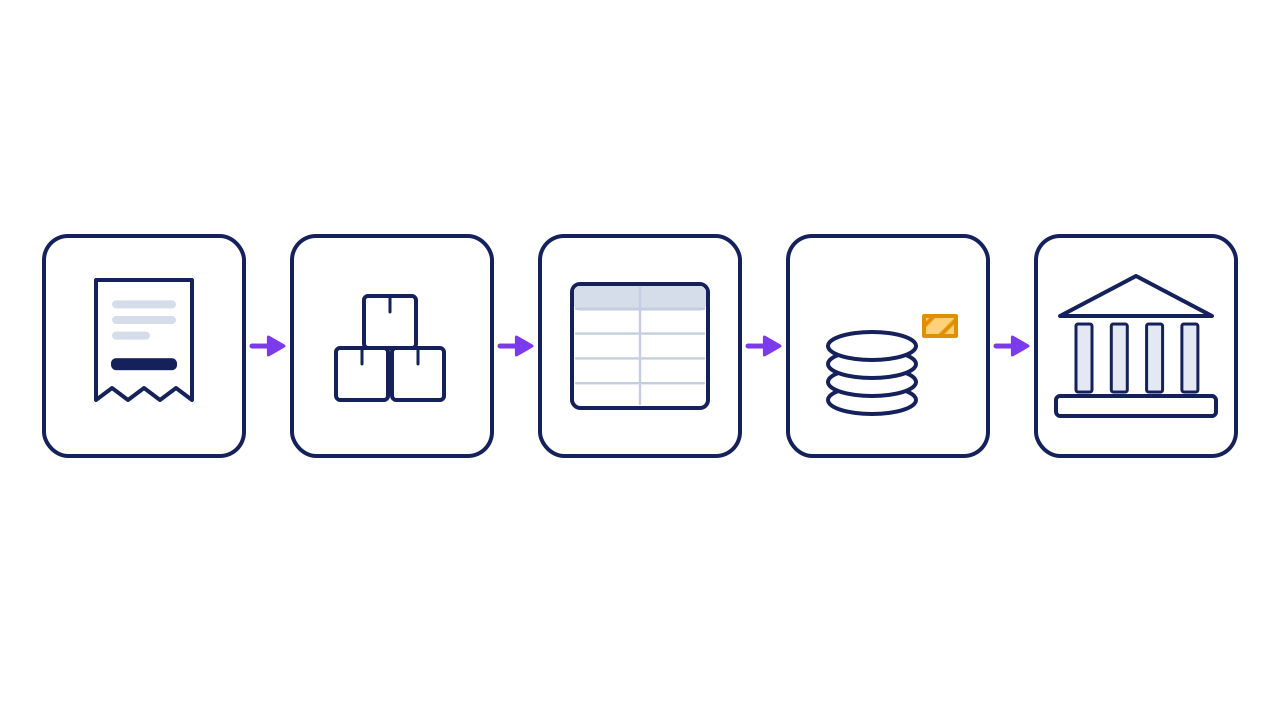
- The order: price, discount, shipping and tax.
- Stock: units set aside for the order.
- The sale: booked at full price, tax on its own line.
- The payout: your orders, minus fees and refunds.
- The bank: the payout matched to the deposit.
1. The order: a promise, not money yet
The store records what the customer agreed to pay. That is the price, any discount, shipping and tax.
Example (made-up numbers): 2 mugs at $20, $6 shipping, $3.20 tax. The customer pays $49.20.
2. Stock: set aside the moment the order lands
Units move from Available to Committed. On hand does not change while the order waits to ship (Shopify's inventory help).
Example: 10 mugs on hand. After the order, 8 are available and 2 are committed. On hand is still 10.
3. The sale: full price, tax on its own line
Book the sale at full price, before fees. The tax form some platforms send, Form 1099-K, reports a gross amount, with no fees, refunds or shipping taken out (IRS).
Tax you collect is owed, not earned. One state's guide calls it a debt you owe the state (Nebraska).
Example: sales $40, shipping $6, tax owed $3.20.
4. The payout: your orders, minus fees and refunds
Fees come out before the money reaches your bank. One platform's help says so plainly (Square). Refunds come out of your balance first (Square). Check how many days each payout covers.
Example (made-up): Monday to Wednesday's orders arrive as one payout on Friday.
5. The bank: the payout matches the deposit
The payout waits in a holding account until the deposit lands. One accounting app calls it Undeposited Funds, a temporary drawer that keeps your books matching the bank (Intuit).
Example: the $2,382 payout sits there until the bank shows $2,382.
Which way to connect
3 ways, from least to most set-up. The "fits when" column and the 15 minutes are our view, not a study.
| Way | What it does | Fits when | Watch for |
|---|---|---|---|
| By hand | You enter one summary for each payout | Under about 20 orders a week | Typing errors. About 15 minutes a week |
| Connector, summary | An app posts one summary per day or payout | Most small stores | Check its account mapping once |
| Connector, every order | Each order posts as its own sale | You invoice business buyers by name | A crowded ledger. Never also enter by hand |
Use it: 3 steps
-
Name one system that owns your stock count.
Every other place that sells reads from it.
Examplethe online store owns stock, and the market stall app reads from it.
Done whenone system's name is written down.
-
Set the books to split each payout into lines.
Sales, shipping, tax owed, refunds and fees each get a line. The payout goes to the holding account first.
Examplea test payout posts as 5 lines, not 1.
Done whenthe next payout posts that way.
-
Tie out one payout every week.
Use the sum below, then match the result to the bank.
Examplethe worked example below.
Done whenthe deposit matches the bank to the cent.
sales + shipping + tax collected − refunds − fees = the deposit
Worked example: one payout, tied out
A small store gets one payout on Friday for Monday to Wednesday.
| Line | Amount | Where it goes in the books |
|---|---|---|
| Sales of goods | $2,250 | Sales |
| Shipping charged | $150 | Shipping income |
| Tax collected | $180 | Tax owed, not income |
| Refunds | −$120 | Refunds |
| Fees | −$78 | Fee expense |
| Deposit | $2,382 | Holding account, then the bank |
The check: $2,250 + $150 + $180 − $120 − $78 = $2,382. The bank shows $2,382. It ties out.
The wrong way, for contrast: book $2,382 as sales. Then $180 of tax counts as income, and $78 of fees and $120 of refunds disappear from view.
Your turn: tie out this week's payout
| Line | Amount |
|---|---|
| Sales of goods | |
| Shipping charged | |
| Tax collected | |
| Refunds (subtract) | |
| Fees (subtract) | |
| Deposit by the sum | |
| Deposit the bank shows |
If it goes wrong
Common mistakes, and the fix for each.
-
The deposit is booked as sales.
Spot itsales in the books equal bank deposits exactly.
Fix itsplit each payout (step 2).
-
2 places change stock.
Spot itan item sells after it ran out. Check the store's "Continue selling when out of stock" setting too (Shopify's tracking help).
Fix itone owner of stock (step 1).
-
An order lands twice.
Spot ita day's sales in the books are double the store's report.
Fix itstop entering by hand once a connector posts.
-
Tax is booked as income.
Spot itno "tax owed" balance.
Fix itgive tax its own line.
Check your work
Do-confirm checklist. Do the work, then confirm each line.
Answer from memory, then open the answers.
Why is a payout smaller than that week's sales?
Show the answer
Fees and refunds come out before it reaches the bank.
Where does sales tax you collect go in the books?
Show the answer
In "tax owed". It is money you owe, not income.
When this is not enough
- You build items from parts. You need to track what each item costs to make. That needs inventory software.
- Stock in several warehouses. Count by location, and pick a tool that does.
- Your accountant uses another method. Theirs wins. Show them the tie-out sheet.
Your next step
tie out your last payout by hand. It takes 15 minutes. If it does not match the bank, find which of the 5 stops holds the gap.
Go deeper: what the numbers mean
Show the detail
Available, Committed and On hand. Available is what you can sell. Committed is set aside for orders not yet shipped. On hand is everything at a place, both of those included (Shopify's inventory help).
A refund can cost you the fee as well. On one platform, the fee on the first sale is not returned when you refund (Square). Check your own platform's rule.
Read next
Sources
- Shopify Help Center, "Understanding inventory states." help.shopify.com/en/manual/products/inventory/fundamentals/inventory-states
- Square Support Center, "Learn about Square fees." squareup.com/help/us/en/article/5068-what-are-square-s-fees
- Square Support Center, "Manage customer refunds." squareup.com/help/us/en/article/6116-process-refunds
- Shopify Help Center, "Set up inventory tracking." help.shopify.com/en/manual/products/inventory/getting-started-with-inventory/set-up-inventory-tracking
- Intuit QuickBooks, "Managing your Undeposited Funds account." quickbooks.intuit.com/learn-support/en-us/help-article/bank-deposits/whats-undeposited-funds-account/L6Jan3iRK_US_en_US
- IRS, "Instructions for Form 1099-K," Box 1a. irs.gov/instructions/i1099k
- Nebraska Department of Revenue, "Statutory Responsibilities for Collecting, Reporting, and Remitting Sales Taxes," guide 4-787, April 2024. revenue.nebraska.gov/sites/default/files/doc/info/4-787.pdf
About this guide
- How it was made
- drafted with AI from the 7 public sources above. No Paper St client notes were used.
- How it was checked
- each number against its source, by a checker separate from the drafter, before release.
- Who published it
- Joseph Gomez Salazar. Published Oct 12, 2026. Last updated: not yet.