
How do you run more than one location when you can't be at each one?
By Joseph Gomez Salazar · Paper StPublished Drafted with AI from the public sources listed below. Published by Joseph Gomez Salazar. How we make these guides
Run every location from 3 checks you can do from anywhere. Keep a written standard, the same weekly numbers side by side, and a cash check done by someone else. Most small firms skip the checks. In a 2026 fraud study, 41% of businesses under 100 staff had a management review, against 79% of larger ones (ACFE, 2026).
You'll be able to write a standard, see every location on one board, set the lines that trigger a call, and check cash from anywhere.
- You'll get
- a one-page standard to copy, a 6-number Monday board, and an 8-line checklist.
- Expect
- about 7 minutes to read, and about 2 hours over 2 weeks to set up.
- For
- owners with 2 or more locations, or about to open a second, who can't be at each one every day. Not for: franchise brands with a head office and an operations team.
- Could a new manager open and close from a written page?
- Do you see every location's numbers on Monday without calling anyone?
- Does someone other than the person who takes the cash check the deposits?
3 yeses? Skip to "If it goes wrong". Any no? Start with Phase 1.
Phase 1: write the standard
Phase 1 of 3 · this week · 1 hour
-
List the 5 jobs that must go the same way everywhere.
Most share a few: open, close, count the cash, serve, check the work.
Examplea 3-location coffee shop picks open, close, cash count, take an order, and clean-down.
Done whenyou have 5 jobs, not 25.
-
Write each job as a one-page checklist, in order.
Have your best manager say it aloud while you type. What staff learn on the job fades: in a study of 36 pizza stores, it faded fast (Darr and others, 1995).
Example"Close: count the drawer with a second person. Photo the count sheet to the owner."
Done whensomeone new follows the page once without calling you.
-
Name one lead per location, with a "call me when" rule.
Write what they decide alone, and what they call you about.
Example, made-up numbers"Refunds under $100: your call. No opener by 7 am: call me."
Done wheneach lead has read and signed their rule.
Copy it once for each of your 5 jobs.
Job
[Close the shop]
Who
[The closing lead, with one other person]
When
[Every night, after the last customer]
Steps
[5 to 10 lines, in order. Only the steps people skip or get wrong.]
Done looks like
[Drawer counted by 2 people, count sheet photo sent]
Call me if
[The count is off by more than $20]
Phase 2: see every location on one board
Phase 2 of 3 · next week · 45 minutes
-
Pick 6 numbers, the same at every location.
One management method puts 5 to 15 numbers on a weekly scorecard (EOS). Start with sales, orders or jobs, labor hours, missed calls, cash over or short, and one quality number.
Examplethe quality number is refunds, redo jobs, or reviews under 4 stars.
Done wheneach number has one written definition, like "sales = before tax, after refunds".
-
Get the numbers onto one board every Monday.
Pull them from the apps each location already runs. A shared sheet is fine to start.
Examplethe board below, one column per location.
Done whenthe board is full by Monday 9 am without a single phone call.
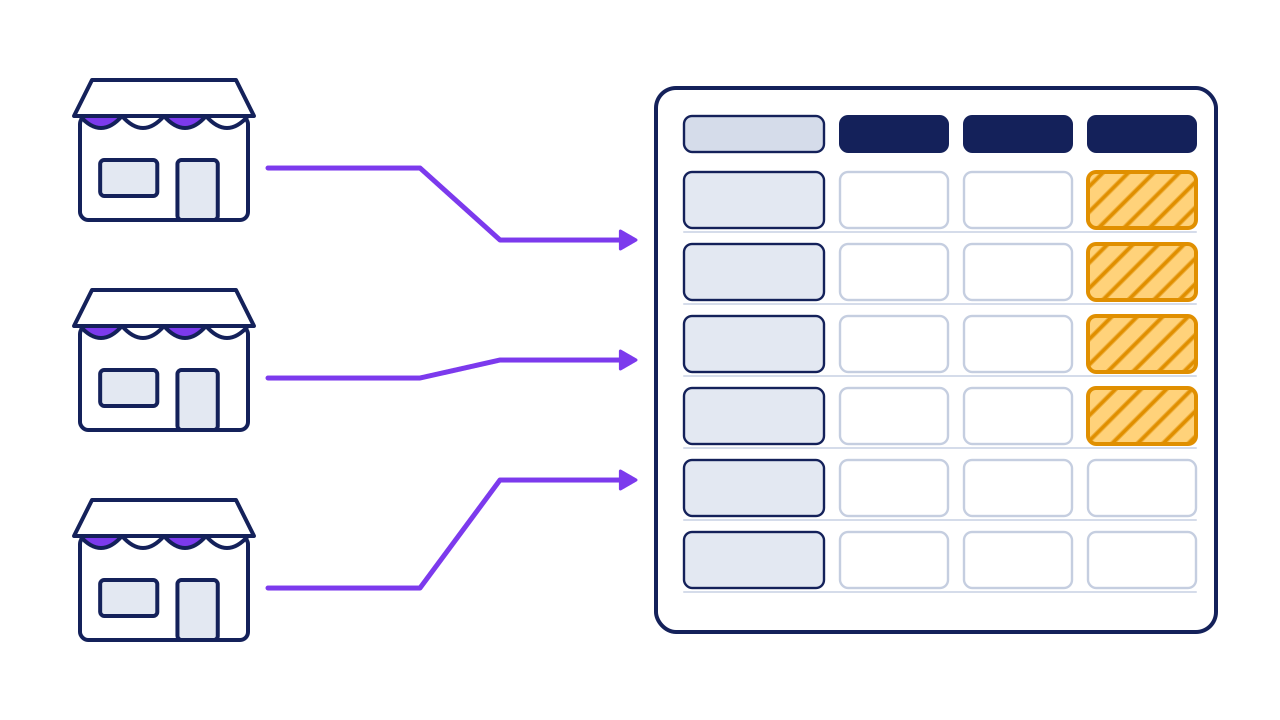
- Each location's apps: the till, the schedule, the phone system.
- Numbers pulled, not retyped: the same 6 from every location, every Monday.
- One board: a column per location, a row per number.
- A red line crossed: the hatched cells. That is the only call you make.
-
Set a red line for each number.
A red line is the point where you pick up the phone. Until a number crosses it, the lead handles it.
Example, made-up numbers"Cash over or short by more than $20 in a week: call."
Done whenevery number on the board has a red line.
Phase 3: check the cash without being there
Phase 3 of 3 · this month · 30 minutes a week
-
Split taking the cash from checking it.
The person who takes the money should not record the deposit. In the fraud study, a third of cases happened where controls were missing (ACFE, 2026).
Examplethe lead counts the drawer. You or a bookkeeper match each deposit to the till report weekly.
Done whenevery deposit this month matches a sales day.
-
Do one surprise check a month.
Count a drawer, or compare stock to sales, on a day nobody knows ahead. Only 16% of small businesses did surprise audits, against 52% of larger ones (ACFE, 2026).
Examplea Tuesday at one location, a late Friday at another.
Done whenthe next date is on your calendar and nobody else's.
-
Give staff a private way to tell you.
Tips caught 43% of frauds, more than any other method (ACFE, 2026). A plain email address only you read is enough to start.
Examplea card in the back room: "See something wrong? Email [address]. Only the owner reads it."
Done whenevery staff member has seen the card.
Worked example: one Monday board, read in 5 minutes
An owner runs 3 locations and reads the board on Monday morning.
| Number | Red line | Downtown | Eastside | Airport |
|---|---|---|---|---|
| Sales, change on last week | down 15% | up 2% | down 4% | down 22% |
| Labor hours | over 380 | 342 | 355 | 391 |
| Missed calls | over 10 | 4 | 6 | 17 |
| Cash over or short | over $20 | $3 | $6 | $48 |
| Refunds | over 12 | 5 | 7 | 9 |
| Reviews under 4 stars | over 2 | 0 | 1 | 1 |
What the owner does: one call, to Airport. It crossed 4 red lines. The other 2 leads get a thank-you text.
Is the board worth 2 hours? Use your own numbers:
5 hours × 52 weeks = 260 hours a year
It is an estimate. You will still visit, just not to find out what happened.
hours a week you spend calling or driving to check × 52 = hours a year to win back
Your turn: your Monday board
| Number | Red line | Location 1 | Location 2 | Location 3 |
|---|---|---|---|---|
| Sales, change on last week | ||||
| Labor hours | ||||
| Missed calls | ||||
| Cash over or short | ||||
| Refunds | ||||
| Your quality number |
If it goes wrong
Common mistakes, and the fix for each. These are our view, not a study.
-
The standard is too long to use.
Spot itpages longer than one screen, and steps nobody ticks.
Fix itcut to the steps people skip. The rest is training.
-
Each location counts a number its own way.
Spot itone location's sales jump when nothing changed.
Fix itone written definition per number (step 4).
-
The board looks fine, but customers do not.
Spot itno number crosses its red line, yet complaints rise.
Fix itkeep one quality number, and visit on a surprise day (step 8).
Check your work
Do-confirm checklist. Do the work, then confirm each line.
Answer from memory, then open the answers.
What 3 things let you run a location you can't visit?
Show the answer
A written standard, the same numbers side by side, and a cash check by someone else.
What is a red line?
Show the answer
The point on a number where you pick up the phone. Until a number crosses it, the lead handles it.
When this does not apply
- You stand in your one location every day. You may not need a board yet. Start with the written standard.
- Your franchise brand already sets the system. Use its numbers and checks first, and add only what it leaves out.
- Your locations do different work, like a shop and a warehouse. Share the cash checks, and pick numbers for each kind of site.
Your next step
write the page for your riskiest job, the cash close. It takes 30 minutes. Ask one lead to follow it on Friday, then fix what they trip on.
Go deeper: the control gap, checked
Show the detail
Why write it down. In the pizza study, know-how passed between stores with the same owner, but not between owners (Darr and others, 1995). It also faded fast. In our view, a written page is how one location's lesson reaches the next.
| Control | Under 100 staff | 100 staff or more | What it looks like in a small business |
|---|---|---|---|
| Management review | 41% | 79% | You read the Monday board and act on red lines |
| Hotline or a way to report | 24% | 85% | A private email only the owner reads |
| Proactive data monitoring | 17% | 58% | Deposits matched to till reports every week |
| Surprise audits | 16% | 52% | One unannounced count a month |
The gap in small businesses. The fraud study compared controls by size. Here are the 4 that matter most when you can't be there.
Source: ACFE, 2026, Figure 30. Across the study, having a control went with losses 37% lower on average (same report). Median loss at businesses under 100 staff was $126,000 (same report).
Two traps to avoid:
1. These are cases fraud examiners worked on, 2,402 of them (same report). They are not a random sample of businesses, so the rates show direction, not your odds. 2. A control that exists is not a control that runs. A board nobody reads on Monday counts as no review.
Read next
Sources
- Association of Certified Fraud Examiners, "Occupational Fraud 2026: A Report to the Nations" (2,402 cases, 143 countries), pages 23, 32, 39, 44 and 49. acfe.com/-/media/files/acfe/pdfs/rttn/2026/2026-report-to-the-nations.pdf
- ACFE press release on the 2026 report, 12 May 2026 (43% of frauds found by a tip). acfe.com/about-the-acfe/newsroom-for-media/press-releases/press-release-detail?s=occupational-fraud-2026-a-report-to-the-nations-pr
- EOS Worldwide, "A Great Week = A Great Scorecard" (5 to 15 numbers, reviewed weekly). eosworldwide.com/blog/great-week-equals-great-scorecard
- Darr, Argote and Epple, "The Acquisition, Transfer, and Depreciation of Knowledge in Service Organizations: Productivity in Franchises," Management Science 41(11), 1995. Abstract. econpapers.repec.org/RePEc:inm:ormnsc:v:41:y:1995:i:11:p:1750-1762
About this guide
- How it was made
- drafted with AI from the 4 public sources above. No Paper St client notes were used.
- How it was checked
- each number against its source, by a checker separate from the drafter, before release.
- Who published it
- Joseph Gomez Salazar. Published Oct 10, 2026. Last updated: not yet.